Product/web
Demo center
Product Strategy: Rearchitecting the B2B Sales Funnel to Shorten Enterprise Deal Cycles
Year :
2023
Industry :
Saas
Client :
Sprinklr
Project Duration :
3 Months

Challenge
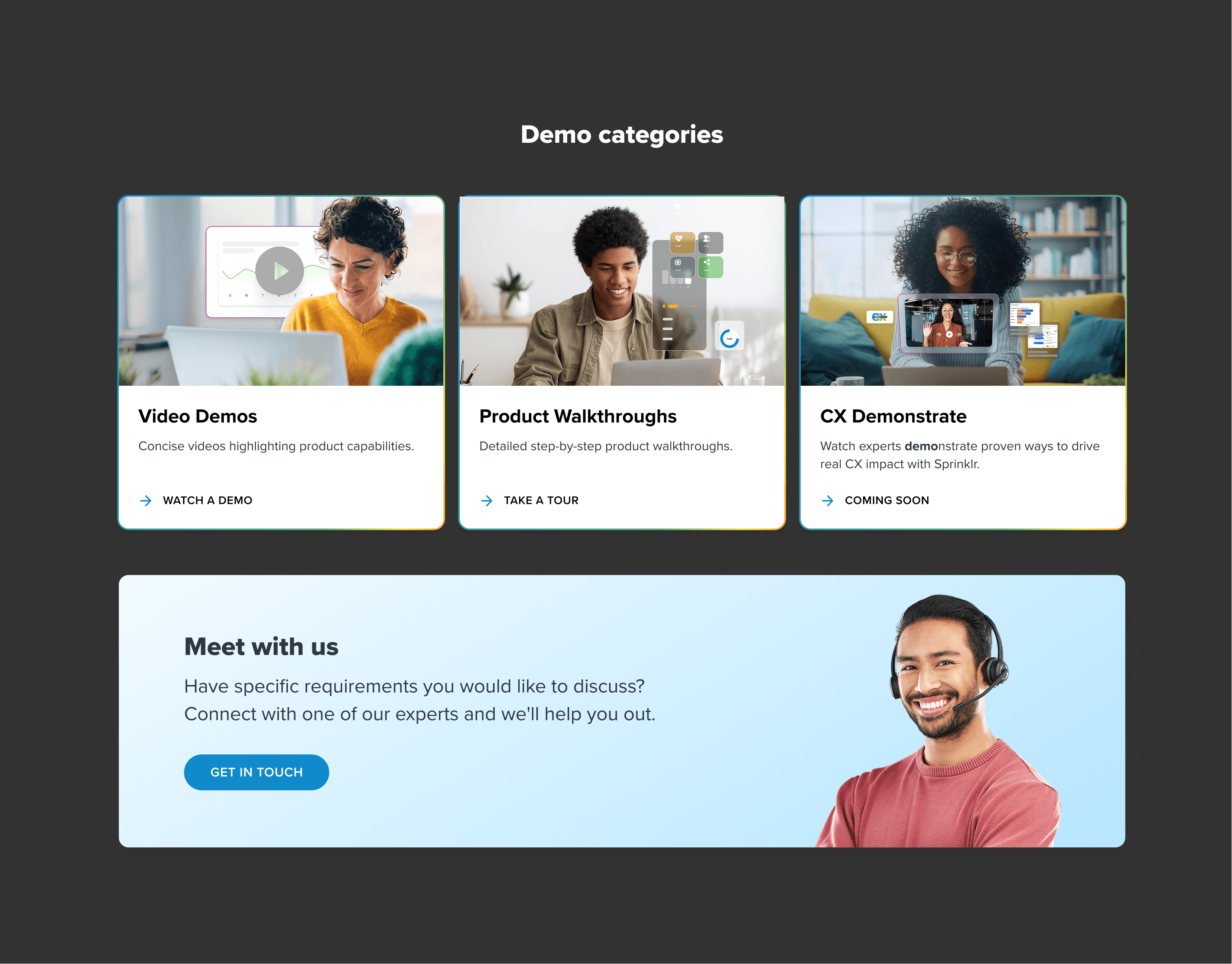
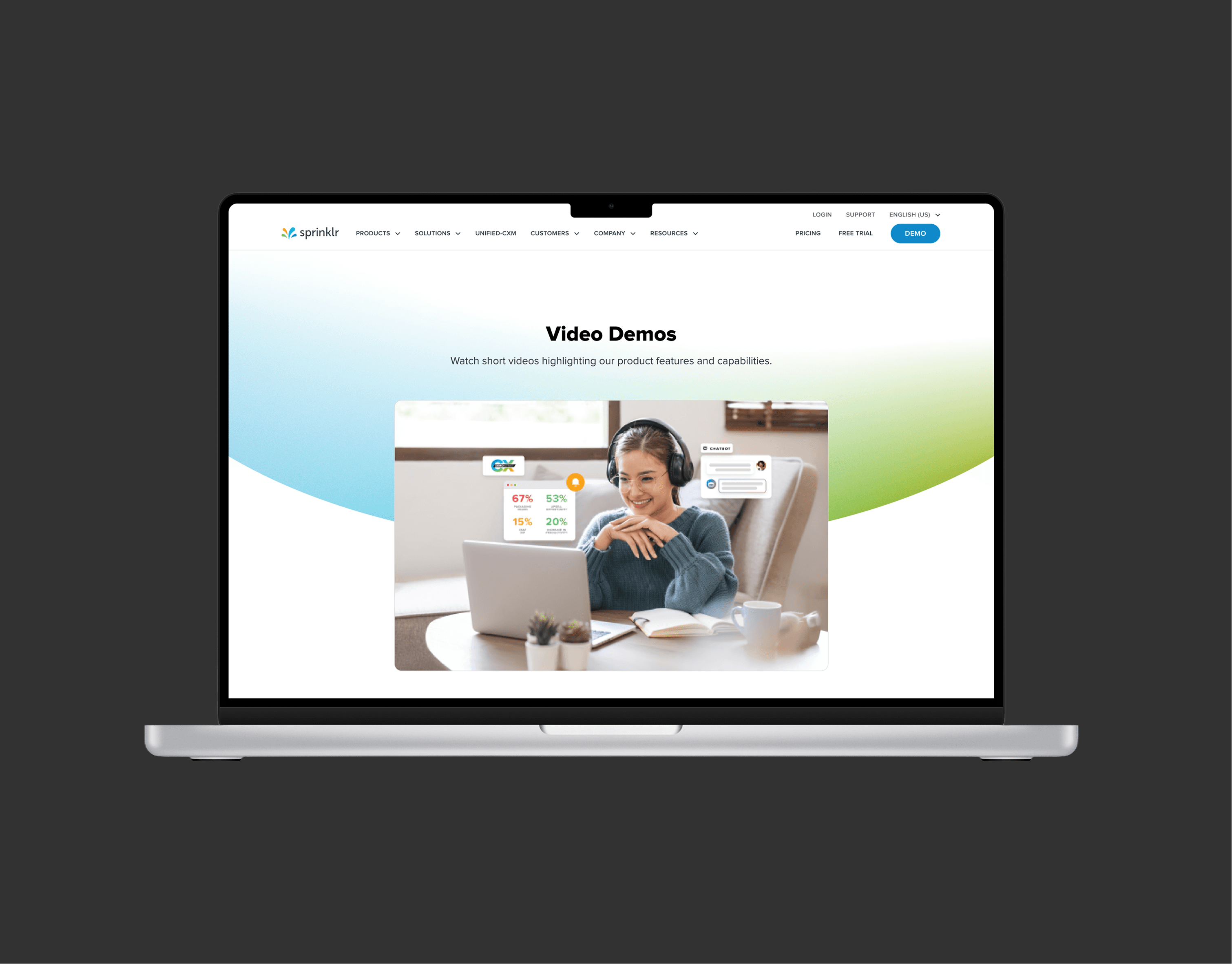
The challenge we faced wasn't a lack of video or demonstration content, but a crucial organizational gap: prospective buyers were overwhelmed by scattered resources and couldn't easily map their level of interest to the right asset. This friction slowed the hand-off to sales and created poor initial impressions. Our strategic goal was to design a focused, high-intent destination—the Demo Center—that clearly segmented content based on user commitment, thereby reducing friction and accelerating the lead-to-MQL pipeline. Success was measured by the completion rate of Product Walkthroughs and the quantity of high-quality CX Demonstration registrations.
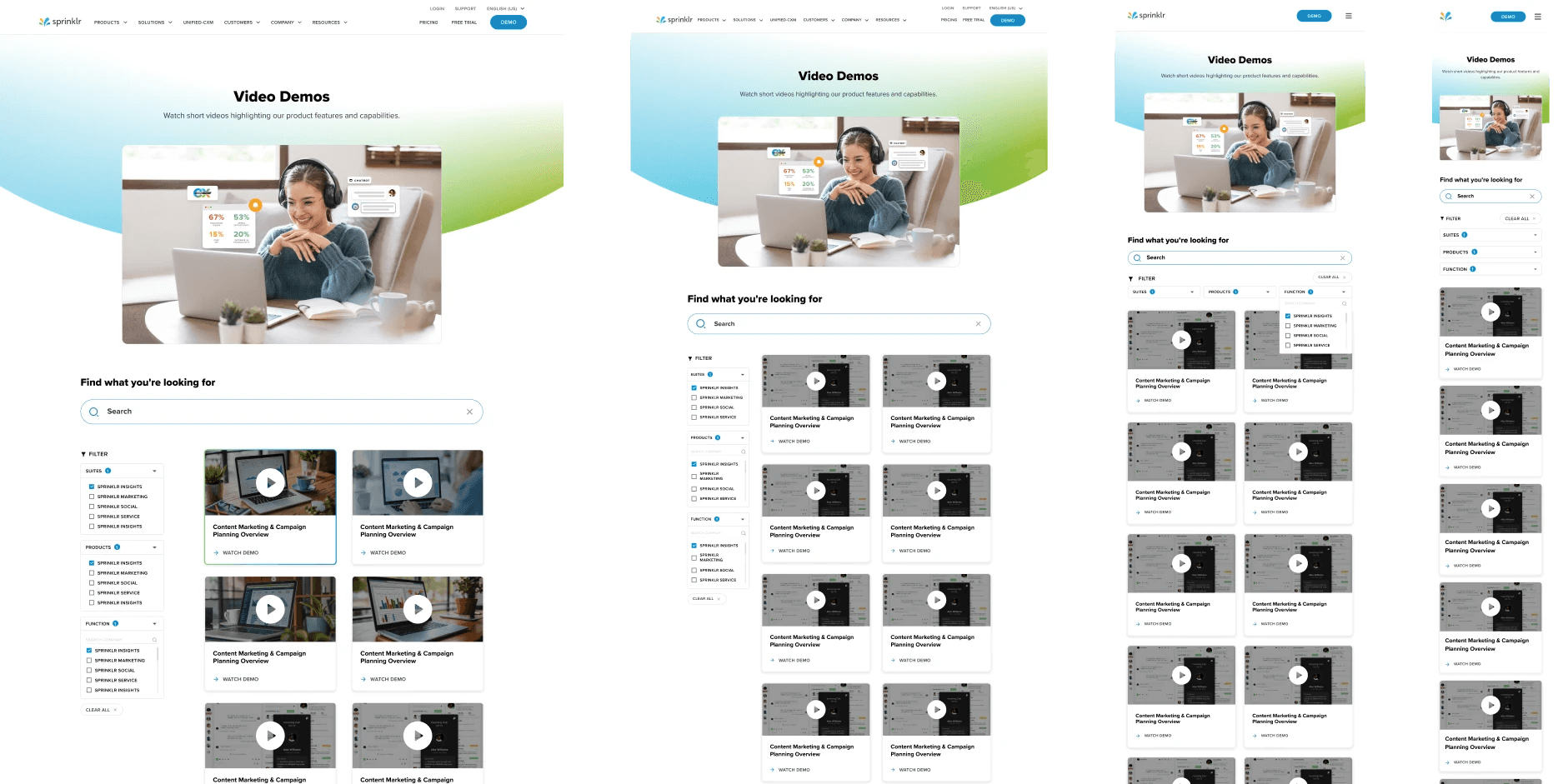
Our design process began with a critical analysis of user mindset. We quickly determined that mixing our three core content types—Video Demos (quick, passive interest), Product Walkthroughs (active, deep exploration), and CX Demonstrations (high-intent, expert-led sessions)—would be confusing. This early insight led us to reject the initial "Wall of Videos" concept, where all media were blended. We understood that a user looking for a 60-second clip had a fundamentally different need than one ready to sign up for a personal demonstration. We pivoted to a clean, card-based landing page, explicitly segmenting content by the level of commitment required.
Cross-Functional Decision-Making
The Demo Center served as a central hub bridging Marketing, Sales, and Product objectives. I worked with Sales Enablement and Marketing Operations teams to clarify user intent across three distinct content tiers: Video Demos for curiosity, Product Walkthroughs for exploration, and CX Demonstrations for commitment-level interest.
One of the most debated elements was the CX Demonstrations section. The Sales team advocated for a strict gate to capture high-quality leads, while others feared this would block early engagement. Partnering with the Product Manager and Legal, I helped define a tiered-access structure—users could view high-level overviews freely, with form submission required only at the point of registration. This ensured early discovery remained open, while still collecting high-intent leads for Sales, aligning business impact with user trust.
The Strategic Pivot
Our biggest strategic learning moment occurred post-launch. Data showed surprisingly strong engagement with the Product Walkthroughs—the detailed, step-by-step tours—indicating our users were less interested in passive watching and more interested in active doing. This contradicted our initial assumption that short Video Demos would be the primary driver. We immediately pivoted the visual hierarchy, giving the Walkthroughs a more prominent card and clearer call-to-action on the landing page. This was a strategic choice to align the design with proven user behavior, prioritizing the feature that most effectively converted curious visitors into qualified, hands-on leads.
The Big Pivot: Emphasizing Interactive Walkthroughs
Our most significant learning moment came from analyzing early engagement patterns. We had initially focused our visual and promotional energy on the short Video Demos, assuming they were the primary entry point. However, data revealed that users who clicked on the Product Walkthroughs (the detailed, step-by-step tours) were significantly more likely to convert into qualified leads. We pivoted our visual strategy immediately: we elevated the Walkthrough card with more prominent sizing and a clearer call-to-action (CTA). This strategic shift reflected the reality that our high-value user was not looking for a passive video, but an active, hands-on opportunity to engage with the product's interface.
Product Thinking: The Next Evolution
A common strategic gap among B2B demo centers is the cold hand-off between the self-service content and the human Sales team. The transition often forces a user to repeat their interest or context in a subsequent email or call.
My strategic proposal is the introduction of a "Contextual Session Summary." This feature would monitor which Video Demos were watched and which Product Walkthroughs were completed. The Strategic Opportunity is to use this gathered data to pre-populate a summary for the user just before they sign up for a CX Demonstration. This summary could say: "Based on your interest in 'Social Customer Service' and completing the 'Omnichannel Routing' walkthrough, our expert will focus on..." This design move demonstrates that Sprinklr has been listening to the user's journey, transforming the cold lead hand-off into a warm, personalized introduction.